

The schedule is locked, the owner is watching milestones, and a key role is still open. For leaders on data center and other mission-critical builds, the next question is not only who to hire. It is how and when to hire them. The contract to hire vs direct hire decision affects how fast someone can start, how much risk you carry if the fit is wrong, what the role really costs, and whether the best candidates will say yes.
There is no single right answer. The better model depends on how well defined the role is, how long you need the person, and what a wrong hire would cost the project. This guide explains how each model works, where each one fits on critical construction work, and the questions that make the decision easier.
Key Takeaways
- Contract-to-hire starts as a contract placement with a planned path to a permanent offer. Direct hire puts the person on your payroll from day one.
- Contract-to-hire suits roles that are still taking shape, projects with uncertain duration, projects that need specialized skills on site right away, or situations where you want to see the work before committing.
- Direct hire suits stable, long-term, high-accountability roles, especially when top candidates will not accept a trial period.
- Onboarding, safety, and compliance responsibilities are shared with the staffing partner on contract assignments, so things like background checks, drug screenings, travel, and site orientation not only matter just as much as they do for direct hires, but need to be coordinated smoothly with the staffing partner.
- Candidates have preferences too. Offers that spell out conversion terms attract stronger talent than vague promises of a permanent role.
What Contract to Hire vs. Direct Hire Actually Means
Both models can solve the same staffing gap, but they are built on different employment structures.
How contract-to-hire works
Contract-to-hire, sometimes called temp-to-hire or contract-to-perm, starts as a contract assignment that is designed to convert to a permanent role. During the contract phase, the professional works on your project while a staffing partner typically serves as the employer of record and handles payroll and administration, as well as required employee benefits and state and federal employment compliance. The contract period often runs a few months, though the length varies by role and project. At the end, you decide whether to convert the person, extend the contract, or end the assignment.
How direct hire works
With a direct hire, the professional joins your payroll as a permanent employee from the first day. A staffing partner may find, screen, and present candidates, but there is no trial phase. You take on salary, benefits, onboarding, and the full commitment right away, in exchange for a long-term relationship from the start.
Contract to Hire vs Direct Hire: Side-by-Side Comparison
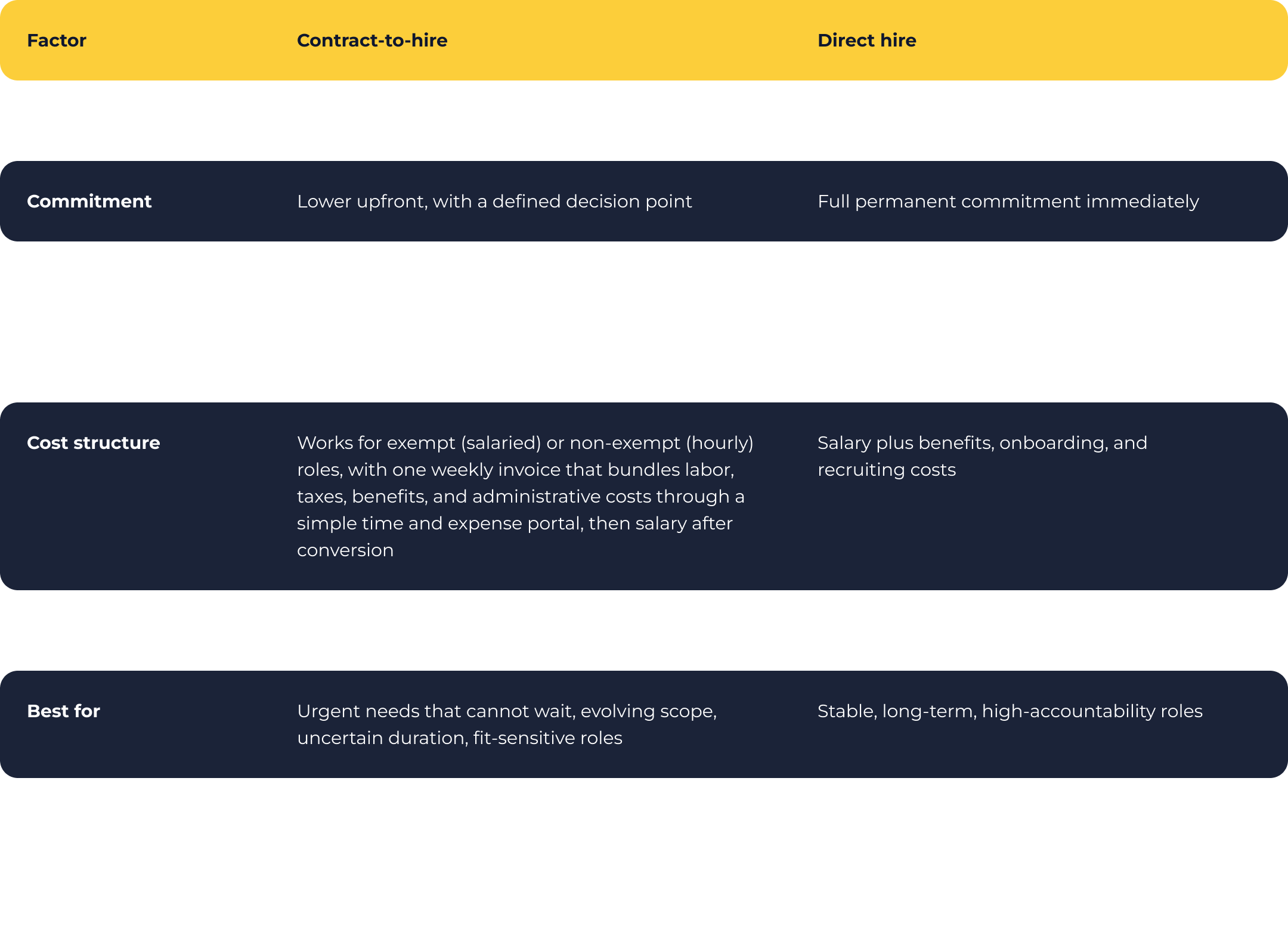
The table is a starting point. The real answer comes from the project in front of you.
When Contract-to-Hire Fits a Critical Construction Project
Contract-to-hire works best when some part of the staffing picture is still uncertain. It brings speed and flexibility while still allowing for thoughtful headcount growth. These are the situations where it tends to earn its place:
- The role is still taking shape. If the scope changes once the work begins, a contract phase lets you adjust before locking in a permanent position.
- Needs shift by project phase. On a typical build, trades across CSI MasterFormat Divisions 1 through 32, from general requirements to site work, call for different skills and headcount at different points, and many of those roles are no longer needed once their phase wraps up.
- Fit matters as much as skill. As we explored in why the hire who looks best on paper can still derail a data center project, a strong resume does not guarantee strong performance under real project pressure. A contract phase lets you see the work, the communication style, and the leadership instincts before you commit.
- You need someone on site quickly. A staffing partner with a vetted network can often shorten the path from open role to first day.
- Corporate headcount restrictions are in place. Hiring freezes and headcount caps often apply only to permanent positions, not contract labor. Contract-to-hire lets you bring in the talent a project needs to keep moving, with the option to convert once restrictions lift.
Contract-to-hire works best when it is deliberate. Define the contract length, the conversion criteria, and the expected compensation range at conversion before the first day. Without those, it can feel like a permanent job with extra uncertainty, and candidates notice.
When Direct Hire Is the Stronger Choice
Direct hire makes sense when stability and long-term ownership are the point:
- The role anchors the project or the facility. Site leadership and long-term operations roles carry accountability that benefits from a permanent commitment on both sides.
- Institutional knowledge builds over time. If a role takes months to learn your systems, standards, and people, a short contract may not repay the ramp-up time.
- The talent market is tight for senior leaders.Uptime Institute’s 2025 staffing survey found that hiring new staff ranks among the top three challenges for data center companies heading into 2026. That pressure is strongest for experienced project and site leaders, who often have several offers in hand and are more likely to pass on a trial structure. For these roles, a direct offer can be the competitive move.
- A gap carries a high cost. Every day a project slips can carry serious financial consequences, as we outline in our look at the financial risk of project delays. If a missing leader could put the schedule at risk, the confidence a permanent offer signals can help you secure the right person.
The Cost Question: Bill Rate vs. Total Cost
Contract-to-hire usually carries a higher bill rate, and that number can make direct hire look like the obvious value. It is an incomplete comparison. The contract rate generally bundles costs your staffing partner covers, such as payroll processing and administrative overhead. Direct hire moves those costs to you.
Benefits alone are significant. In June 2026, the Bureau of Labor Statistics reported that benefits made upabout 30 percent of private industry compensation costs, roughly $14 of every $46.89 spent per hour worked. Add recruiting time, onboarding, and the cost of replacing a miss, and the gap between the two models narrows.
Benefits are only part of the burden. Workers’ compensation coverage, payroll and time and expense systems, and employment compliance all carry real cost. Compliance is especially complex for traveling construction professionals. Tax withholding can change by state, and in some places by county or city, as workers move between job sites. Each jurisdiction also comes with its own reporting requirements on top of federal rules. On a contract assignment, the staffing partner manages that work. On a direct hire, your team owns it.
As a general rule, a short, defined need often costs less under a contract structure, while a long-term core role tends to cost less over time as a direct hire. Your numbers will vary, so compare total cost across the full length of the need, not just the rate on the first page of a proposal.
Safety and Compliance Do Not Change by Hiring Model
On an active mission-critical site, the hiring model does not lower the safety standard. OSHA treats the staffing agency and the host employer as joint employers of workers supplied to a host employer and paid by a staffing agency, whether or not the job is actually temporary. That makes both responsible for a safe work environment, including training, hazard communication, and recordkeeping. OSHA also recommends that the agency and the host employer spell out their responsibilities in their contract.
In practice, contract-to-hire professionals need the same site-specific orientation, protective equipment, and hazard briefings as any direct hire on day one. Confirm who handles each requirement before the assignment starts, not after something goes wrong.
What Candidates Think About Contract-to-Hire
Staffing decisions are two-sided. The professionals you want have options, and they weigh structure as carefully as pay.
Federal data offers some perspective. In its July 2023 survey, the U.S. Bureau of Labor Statistics found that 44.8 percent of contingent workers would have preferred a permanent job, while 40.8 percent preferred their contingent arrangement. That survey covers contingent work broadly, not only contract-to-hire, but it shows that preferences are split and that a trial structure is not an automatic draw.
Candidates who hesitate are usually not rejecting the idea of a trial. They are reacting to uncertainty about what happens at the end of it. As we covered in why strong candidates often walk away before the offer, confidence is built or lost through the details of the process. To keep strong talent engaged, be specific:
- State the contract length and the decision timeline.
- Share the expected compensation range and benefits at conversion.
- Explain what success looks like during the contract phase.
- Communicate consistently, not only at the end.
Framing matters too. Avoid presenting the contract period as “probationary,” which often carries a negative connotation. Position it instead as a faster path from interview to on site. Contract-to-hire professionals are onboarded like anyone else on the project, and they get a real chance to experience your culture and operating procedures before making a long-term commitment, all while being paid for their work.
How to Choose Between Contract to Hire vs. Direct Hire
Walk each open role through five questions:
- Is the position critical, and has your talent acquisition team struggled to find the right talent, or enough of it? If the search has stalled, a staffing partner’s network can widen the pool, and contract-to-hire can get someone on site while the long-term decision plays out.
- Geographically, will you find talent that will put down roots here? If local candidates who will stay long term are scarce, contract-to-hire lets traveling professionals take on the work and decide whether the location fits them. If committed local talent is available, direct hire makes sense.
- Is this a specific need for a specific scope that will not continue beyond the project? A defined, project-only need favors a contract structure. A role that continues after the project favors direct hire.
- Is there an opportunity to bill their time back to an end client? Depending on your business model, contract labor costs may pass through to the project owner, which can make a contract structure easier to fund.
- Is the project asking for a skill set your organization does not have in-house? Contract-to-hire lets you bring that expertise in now and decide later whether it belongs on your team permanently.
Most large projects use both models. Leadership roles such as project managers, directors, and VPs tend to be direct hires, while contract-to-hire is often used for site-specific, project-based roles: professionals brought on to get a specific project done, or added where project needs can expand and contract quickly. If the fit is right and more projects need that skill, those professionals can convert to permanent roles. That makes contract-to-hire especially useful when your pipeline beyond the current project is uncertain. Adata center staffing and recruiting partner that understands mission-critical work can help you map each role to the right model and present it clearly to candidates.
Choose the Right Model Before the Schedule Chooses for You
The right hiring model protects your timeline, your budget, and your team’s confidence. The wrong one can add risk at the moment you can least afford it.
Reliant Critical Infrastructure is a veteran-operated staffing and recruiting company serving mission-critical operations, and data centers. Whether you are weighing contract-to-hire, direct hire, or a blend of both for a current build, talk with the Reliant Critical Infrastructure team about your roles and your timeline.
Frequently Asked Questions
Q: What is the difference between contract-to-hire and direct hire?
A: Contract-to-hire starts as a contract assignment, usually through a staffing partner, with a planned path to a permanent offer. Direct hire makes the person your permanent employee from day one. The main differences are who employs the person at the start, how much commitment you take on upfront, and how you evaluate fit.
Q: Is contract-to-hire cheaper than direct hire?
A: It depends on how long you need the role. Contract-to-hire usually has a higher bill rate, but it bundles the partner’s payroll, workers’ compensation, systems, and compliance costs, while direct hire moves those costs to you along with benefits, onboarding, and replacement risk. Short, defined needs often favor contract structures, and long-term roles often favor direct hire.
Q: How long does a contract-to-hire period last?
A: Many arrangements are set in monthly terms, though the length varies by role, project, and agreement. Set the length, the conversion criteria, and the decision date in writing before the assignment begins so everyone knows what to expect.
Q: Do contract-to-hire employees receive benefits?
A: During the contract phase, benefits typically come from the staffing partner, and offerings vary by firm. After conversion, the person joins your benefits plan like any other permanent employee. Ask about benefits up front, since candidates will.
Q: Which is better for critical construction and data center projects, contract-to-hire or direct hire?
A: Neither wins every time. Contract-to-hire fits evolving roles, phased needs, and fit-sensitive positions, while direct hire fits long-term leadership and operations roles. Many mission-critical projects use a mix of both.
Q: Can you convert a contract-to-hire employee early?
A: Often yes, but it depends on the agreement. Some staffing agreements include a minimum contract length or a conversion fee, so review those terms before you sign. Planning conversion criteria in advance also makes an early decision easier.

Written by: Matt Morrissey, SVP, Business Development