

If you’ve worked in the military, industrial environments, construction, power generation, oil and gas, electrical, mechanical, or another demanding technical field, you may already have skills that translate to a data center career.
There is a common assumption about working in the data center industry:
You need data center experience to get data center experience.
For some highly specialized positions, direct experience is essential. But across a much broader range of data center careers, that assumption can cause qualified people to overlook an industry where their existing skills may be more relevant than they realize.
Think about what happens every day in a mission-critical environment.
Equipment has to work. Safety procedures have to be followed. Multiple teams have to coordinate their work. Schedules change. Problems have to be diagnosed quickly. Small mistakes can have much larger consequences, particularly on projects where delays can create significant downstream financial and schedule risk. And when something doesn’t go according to plan, people need to communicate, adapt, and keep moving.
If that environment sounds familiar, there’s a reason. Military installations, manufacturing plants, power generation facilities, oil and gas operations, industrial construction sites, and other complex technical environments demand many of the same behaviors.
The equipment may change. The terminology may be new, and the industry certainly has things you’ll need to learn. But you may not be starting from zero.
Data Center Careers Need More Than Data Center Experience
The data center industry has a talent challenge.
Uptime Institute’s 2025 Global Data Center Survey found that 46% of operators reported difficulty finding qualified candidates for open roles, with electrical and mechanical trades continuing to experience significant talent shortfalls.
At the same time, the range of opportunities is much broader than many candidates realize. Uptime Institute’s Data Center Career Pathfinder identifies more than 230 types of roles spanning the design, construction, and operation of data centers. The resource was specifically created to help people from different backgrounds understand how their skills could translate into the industry.
That’s an important distinction.
A data center isn’t simply a building filled with servers. It depends on electrical infrastructure, cooling and mechanical systems, controls and automation, construction, commissioning, safety, operations, project management, and many other disciplines.
That creates potential entry points for people whose careers didn’t begin inside a data center.
No Data Center Experience Doesn’t Always Mean You’re Unqualified
Hiring managers naturally look for candidates who have already done the job.
Direct experience reduces uncertainty. But when the available talent pool is tight, hiring only from within the same industry can also overlook professionals who already possess much of what the role requires.
Uptime Institute has previously made a similar point in its workforce research, noting that many data center positions require a college or technical education or equivalent experience, and recommending that employers reevaluate requirements to attract a wider pool of talent.
For candidates, that changes the question worth asking.
Instead of: “Have I worked in a data center before?”
Ask: “What have I already done that proves I can succeed in this environment?”
That’s where transferable skills matter.
The goal isn’t to convince an employer that industry experience doesn’t matter. It’s to show them which parts of the job you’ve already learned somewhere else.
Which Technical Backgrounds Can Transfer Into Data Center Work?
There isn’t one path into the industry.
Depending on the position, professionals from several adjacent fields may have relevant experience.
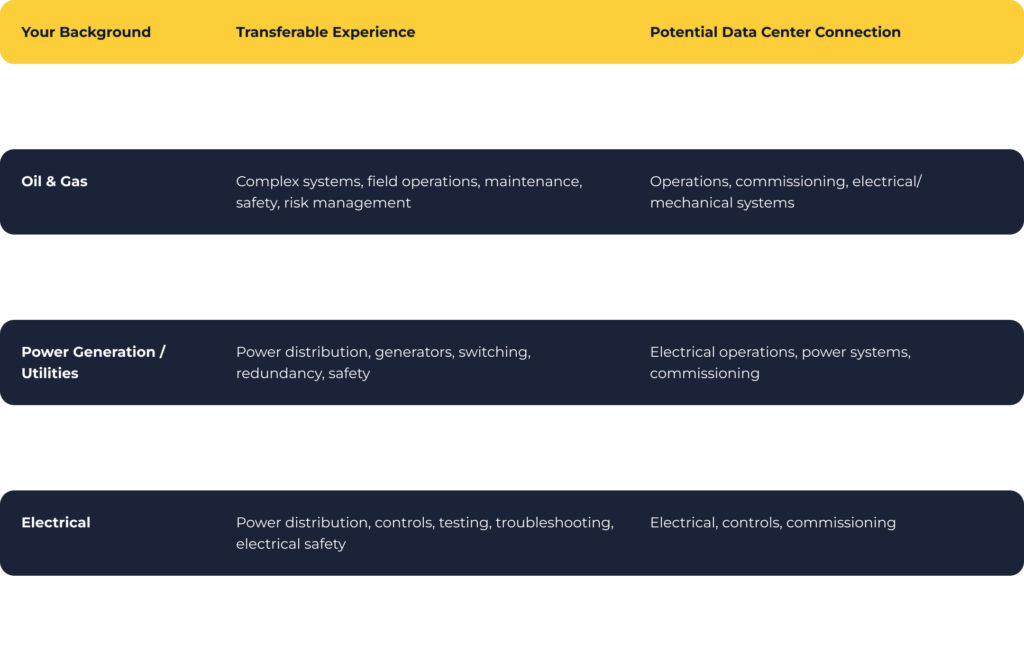
But industry experience and relevant experience aren’t always the same thing. Learning how to recognize and communicate that distinction can open doors to data center careers you may not have considered.
The Skills That Matter When the Pressure Is On
In a recent Reliant article about what separates strong data center professionals from candidates who simply look good on paper, experienced industry leaders repeatedly emphasized communication, adaptability, planning, accountability, and the ability to understand project dependencies.
Those qualities aren’t exclusive to data centers. They’re developed in environments where the work has consequences.
Safety Discipline
Mission-critical environments don’t leave much room for shortcuts.
Candidates who come from industries with rigorous safety procedures often already understand the importance of following protocols, identifying hazards, escalating concerns, and protecting both people and equipment.
You may need to learn a different facility’s procedures. You don’t have to learn why those procedures matter.
Understanding Dependencies
One task rarely exists in isolation on a data center project.
Electrical work can affect commissioning. Controls integration can affect startup. Equipment delays can change the schedule for several other teams.
Reliant’s conversations with experienced data center leaders have reinforced how important it is for professionals to understand these dependencies and the ripple effect one decision can create across a project.
If you’ve coordinated trades on a construction site, managed equipment in a manufacturing facility, worked through shutdowns or turnarounds, or operated within another interconnected technical environment, that way of thinking may already be familiar.
Staying Calm When Conditions Change
Mission-critical doesn’t mean everything goes according to plan. It means the team has to respond effectively when it doesn’t.
Materials arrive late. Equipment fails. Schedules move. Priorities change.
People who have spent years working in demanding technical environments often bring something that can’t easily be taught in a classroom: experience making decisions when the pressure is real.
That judgment is central to how Reliant Critical Infrastructure evaluates talent. Technical qualifications matter, but so do the habits people bring to the job: how they solve problems, communicate under pressure, follow through, and respond when conditions change.
Your Resume May Be Hiding Your Most Transferable Skills
Here’s where candidates changing industries can run into trouble.
Your experience may transfer, but your resume doesn’t explain the connection.
A hiring manager shouldn’t have to figure it out.
If you’re exploring data center jobs, don’t simply list what you did in your previous industry. Show what the experience demonstrates.
For example:
Instead of: “Responsible for equipment maintenance at a manufacturing facility.”
Consider: “Maintained and troubleshot critical electrical and mechanical equipment in a high-availability manufacturing environment, coordinating planned maintenance to minimize operational disruption.”
Or:
Instead of: “Supervised subcontractors on commercial construction projects.”
Consider: “Coordinated multiple subcontractors across complex project schedules, identifying sequencing conflicts and resolving field issues while maintaining safety and schedule requirements.”
You’re not trying to disguise the fact that you haven’t worked in a data center. You’re helping an employer understand why the work you’ve already done matters.
Whenever possible, quantify that experience. The size of the facility, number of contractors supervised, equipment supported, uptime requirements, safety record, project value, or scale of the systems you worked with can help employers understand the complexity you’ve already managed.
What Should I Highlight on My Resume?
If you’re trying to move into a data center career, look for examples that demonstrate:
- Electrical, mechanical, controls, automation, or other technical expertise
- Safety procedures and compliance
- Troubleshooting and root-cause problem solving
- Work in uptime-sensitive or high-consequence environments
- Project sequencing and schedule management
- Cross-functional or subcontractor coordination
- Reading technical drawings, schematics, or specifications
- Preventive maintenance
- Commissioning, startup, testing, or validation
- Leadership under pressure
- Clear communication and documentation
Don’t Just Tell an Interviewer Your Skills Transfer. Show Them.
Your resume gets you into the conversation. The interview is where you prove the connection.
If an interviewer asks about your lack of direct data center experience, acknowledge the gap and then connect your previous experience to what the role requires. Be prepared to explain what you have done.
Use specific examples.
- When did equipment fail unexpectedly and how did you respond?
- When did a schedule change force you to reprioritize work?
- How have you coordinated across multiple teams whose priorities weren’t always aligned?
- When have you identified a safety or quality issue before it became a larger problem?
- How have you learned an unfamiliar technical system quickly?
These stories help a hiring manager see more than your previous industry.
They show how you operate. And in mission-critical work, how you operate when conditions become difficult can matter just as much as where you worked before.
Why Employers Are Widening the Data Center Talent Pool
Persistent workforce shortages are also giving employers reason to think differently about where experienced data center talent can come from. Uptime Institute’s latest research says hiring and retention challenges remain widespread and that the industry needs a sustained effort to attract talent from a broader range of candidate sources.
That doesn’t mean lowering the bar. It means getting more precise about what the bar actually is.
Does the position truly require five years inside a data center? Or does it require someone who understands complex electrical systems, works safely, communicates effectively, responds well under pressure, and can learn the data-center-specific pieces?
Those are very different requirements.
The strongest hiring strategies can distinguish between technical capabilities that must be present on day one and industry knowledge that a capable professional can develop.
Expanding the candidate pool is only part of the equation. Employers also need a hiring process capable of keeping strong candidates engaged, particularly in a competitive market where qualified data center professionals may walk away before an offer is ever made.
That’s also consistent with Reliant’s broader hiring philosophy. As we explored in The Data Center Hire Who Looks Best on Paper Can Still Derail the Project, evaluating talent means looking beyond certifications and project history to understand how someone solves problems, collaborates, adapts, and performs when conditions change.
Why Now Is a Strong Time to Explore Data Center Careers
The industry’s workforce needs aren’t disappearing.
Even as operators make progress with training and recruitment, nearly half continue to report difficulty finding qualified candidates. Meanwhile, Uptime Institute says most data center owners and operators in its research are planning new facilities, expansions, or both.
That creates opportunity. Not necessarily for everyone, and not for every role immediately.
But if you have built a career in an environment where safety matters, equipment matters, uptime matters, schedules matter, and your decisions affect the people working around you, it’s worth looking more closely.
Your next career move may not require starting over. It may require applying what you already know somewhere new. You may need additional training, certifications, or exposure to data-center-specific systems depending on the role. The point isn’t that every technical background automatically qualifies you. It’s that relevant experience can give you a much stronger starting point than you may realize.
Ready to See Where Your Experience Could Take You?
Breaking into a new industry can be difficult when job descriptions don’t make the connection between where you’ve been and where you could go next.
That’s where working with recruiters who understand mission-critical environments can help.
Reliant Critical Infrastructure works with professionals across commissioning, electrical and controls engineering, MEP, automation and BAS, construction and site management, operations, safety, quality, and other critical infrastructure disciplines.
If you’re considering a move into the data center industry, explore current opportunities or connect with our team. We can help you understand where your technical background may translate, which experience employers are likely to value, and where you may need to build additional skills.
CTA: Browse Current Reliant Critical Infrastructure Jobs→ Link to: https://reliantcriticalinfrastructure.com/jobs/
Frequently Asked Questions
How can I get a data center job without experience?
Start by identifying which parts of your existing technical experience transfer to a data center environment. Experience in electrical, mechanical, industrial, construction, military, power generation, oil and gas, controls, and other technical fields can provide a strong foundation. Some roles require specific certifications or direct data center experience, while others may allow you to build data-center-specific knowledge on top of skills you already have.
What transferable skills are useful for data center careers?
Technical troubleshooting, electrical and mechanical knowledge, safety discipline, communication, project coordination, understanding dependencies, documentation, adaptability, and the ability to work effectively under pressure can all be valuable in mission-critical environments.
Is military experience useful for data center jobs?
It can be, particularly when someone’s military experience involves electrical or mechanical systems, power generation, controls, facilities, construction, technical operations, safety, maintenance, or leadership in high-pressure environments. The relevant experience will depend on the specific position.
What types of data center careers should candidates with technical backgrounds explore?
Opportunities can span commissioning, electrical and controls engineering, MEP, automation/BAS, construction and project management, operations, safety and quality, among other areas. Uptime Institute’s Career Pathfinder identifies more than 230 roles across the broader data center industry.
How should I explain transferable skills during a data center interview?
Focus on specific examples rather than general claims. Explain situations where you solved a technical problem, protected safety or uptime, coordinated across teams, responded to an unexpected issue, learned a new system, or kept work moving when priorities changed. Then connect that experience directly to the requirements of the data center position.

Written by: Matt Morrissey, SVP, Business Development